Deep Cleaning (SRP) in Seattle
Your dentist said “deep cleaning” and you want the details. Here’s what happens in the chair, why it’s different from a regular cleaning, and how fast you’ll feel normal again.
The short version
Scaling and root planing, or SRP, is the go-to nonsurgical treatment for periodontitis. It isn’t an extra-thorough cleaning. It treats an infection that a cleaning can’t reach.
One step strips away what’s feeding the infection; the second leaves the root surface clean enough for the gum to tighten back up.
For most people, SRP kicks off an ongoing plan for their gums rather than closing the book.
When a regular cleaning won’t cut it
A routine cleaning, called a prophylaxis, handles the crowns of your teeth and the edge of the gum. For healthy gums, that’s exactly right. Our deep cleaning vs. regular cleaning comparison lays out the differences side by side.
Once gingivitis has progressed to periodontitis and the pockets measure 4mm or more, bacteria sit out of reach of routine tools. A regular cleaning would polish the surface and leave the infection alone. SRP goes where the infection is.
So when we recommend SRP instead of a regular cleaning, it isn’t an upsell. The recommendation comes straight from your pocket measurements, and pockets in the disease range don’t respond to anything less.
In the chair
Split across two visits
We usually treat the left and right sides on separate days. Less of your mouth is numb at once, and the first side gets a head start on healing.
Numbing first
Local anesthetic keeps you comfortable; you’ll register pressure and scraping but not pain. Nervous about dental work? Tell us ahead of time and we’ll plan around it.
The work itself
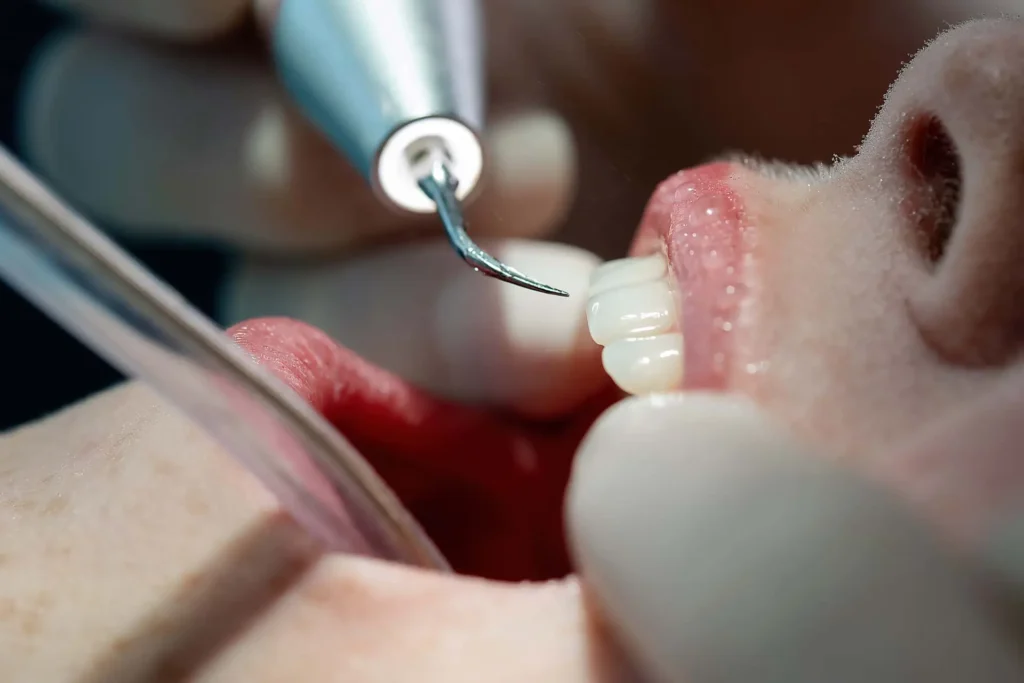
Using hand instruments and an ultrasonic scaler, your hygienist or dentist cleans each root below the gum and then smooths it. Plan on 45 to 60 minutes per side, depending on how much buildup there is.
Afterward
Your gums will be tender and your teeth a bit temperature-sensitive for a few days as the cleaned tissue heals. Ibuprofen or acetaminophen usually covers it, and warm salt-water rinses help. Keep food soft and not too hot for a day or two; our list of What to Eat After a Teeth Cleaning has ideas.
Re-evaluation
Four to eight weeks later, we measure the pockets again to see how the gums responded. Those numbers decide whether anything else is needed and how often you’ll come in from here.
Book a visit
No rush. No judgment. No surprises.
Life after SRP
Once you’ve had SRP, cleanings every six months usually aren’t enough. Most people move to periodontal maintenance: professional cleanings every three to four months.
Periodontitis is managed, not cured. The bacteria behind it never fully leave your mouth, so shorter gaps between cleanings keep them from re-establishing in the pockets and let us track your measurements over time.
With solid home care and steady maintenance, many patients see pockets hold or even shrink. If disease keeps advancing anyway, another round of SRP or a periodontist referral may be next.
The point of maintenance is control: keeping things stable so you never reach surgery or losing teeth. For SRP pricing and insurance details, see our page on gum disease treatment cost.
How much is a deep cleaning?
SRP is billed by quadrant (a quarter of your mouth), so the total depends on how many quadrants need it. Below are our 2026 self-pay prices. Insurance usually brings your share down, and you’ll get a written estimate after we check your benefits.
2026 self-pay prices
- One quadrant $230–$275
- All four quadrants $920–$1,100
- Full-mouth debridement $170
- Maintenance visit $305
Book a visit
No rush. No judgment. No surprises.
SRP FAQs
Is a deep cleaning painful?
Isn’t a deep cleaning just a longer regular cleaning?
Will my insurance cover SRP?
How long does each appointment take?
When will I feel back to normal?
Can gum disease return?
Book a visit
No rush. No judgment. No surprises.